Unreal Engine 5 · Blueprint → C++
Apply Radial Damage in Unreal Engine 5 C++
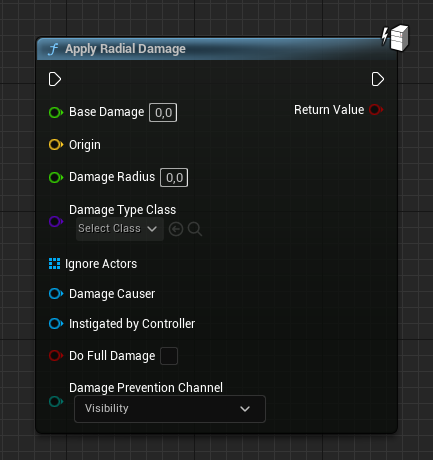
Apply Radial Damage in C++ is UGameplayStatics::ApplyRadialDamage(), which spreads damage to every actor inside a radius around an origin point.
Blueprint node & C++ equivalent
#include "Kismet/GameplayStatics.h"

FVector Origin;
AActor* DamageCauser;
AController* EventInstigator;

UGameplayStatics::ApplyRadialDamage(
	this,                          // World context object
	100.0f,                        // Damage amount
	Origin,                        // Damage location
	200.0f,                        // Damage radius
	UDamageType::StaticClass(),    // Damage type
	TArray<AActor*>(),             // Ignored actors
	DamageCauser,                  // Damage causer
	EventInstigator,               // Instigator
	false                          // Do full damage?
);
What does Apply Radial Damage do?
Apply Radial Damage is the explosion-style node: it damages all actors within a sphere defined by an origin and radius. It is ideal for grenades, AoE abilities, and environmental blasts where a single hit should affect many targets.
Damage can fall off with distance or be applied uniformly depending on the do-full-damage flag.
The C++ equivalent
After including Kismet/GameplayStatics.h, call UGameplayStatics::ApplyRadialDamage(). It takes a world context object (this), the base damage amount, the FVector origin, the radius, a damage type class, a TArray<AActor*> of ignored actors, the damage causer, the instigating controller, and a bool for whether to apply full damage to all targets.
Passing false for the final argument enables linear distance-based falloff, so actors near the edge of the radius take less damage.
When to use it
Reach for radial damage when one event should hit multiple actors at once. Add the source actor to the ignored-actors array if you do not want the explosion to damage its own owner.
Frequently asked questions
How do I do explosion damage in UE5 C++?+
Call UGameplayStatics::ApplyRadialDamage() with an origin, radius, and damage type. It applies damage to all actors inside the sphere.
How do I make radial damage fall off with distance?+
Pass false for the do-full-damage parameter so damage scales down linearly toward the edge of the radius. Pass true for uniform damage.